
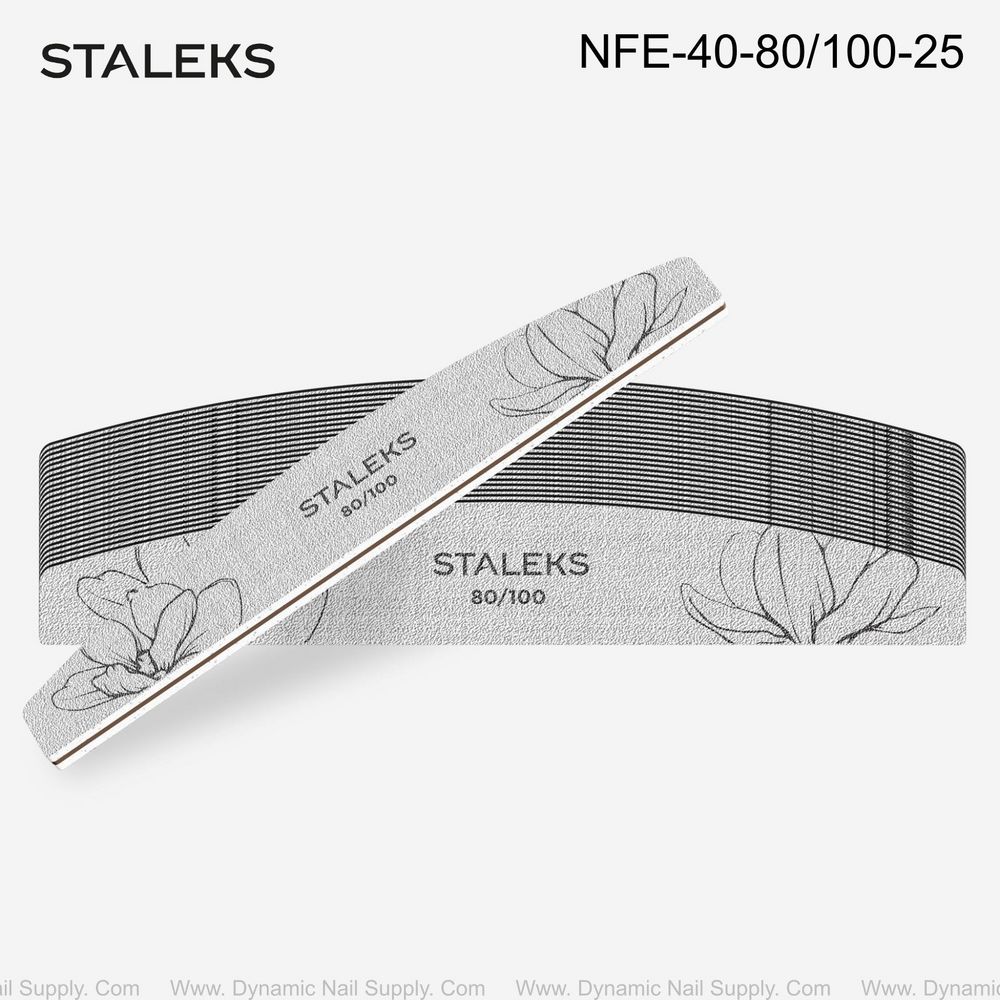
In a busy salon a reliable disposable file that balances material removal and control speeds services and preserves finish quality. The crescent mineral nail file with an 80/100 grit pairing is built for that middle ground: efficient shaping of artificial nails and precise refinement of edges and surfaces.
Why the crescent shape belongs in your kit
The crescent profile combines a curved edge and a straight edge in one tool. That curvature lets the file track sidewalls and contours without forcing the technician to bend or rotate a client’s finger into awkward positions. The straight edge is there when you need a clean plane for shaping free edges. Together these two geometries reduce tool changes and keep each service flowing.
How it fits into a standard salon service
Start the service with your usual sanitation and prep routine, then choose the grit side that matches the task. Use the coarser 80-grit to remove or shorten artificial enhancements, and flip to the 100-grit side to refine shape and smooth surfaces before buffing or finishing. Many salons keep this crescent nail file within reach for quick replacement between clients.
- Step 1 — Prep: Clean and dehydrate the nail area according to your protocol.
- Step 2 — Reduce length: Use the 80-grit for faster shortening of gel or acrylic tips.
- Step 3 — Reshape: Flip to the 100-grit to correct sidewalls and perfect the free edge.
- Step 4 — Finish: Follow with your chosen buffer or low-grit finishing tool to smooth and polish.
Key product features that matter in real service work
- Dual 80/100 grit — Delivers two levels of abrasion for removal and refinement without swapping tools.
- Crescent profile — Curved side for contours; straight side for free-edge shaping.
- Foam-backed abrasive — A thin cushion under the abrasive helps limit excessive pressure on the natural nail plate while you file.
- Flexible plastic base — Conforms to working angles so the file feels controlled and predictable in hand.
- Anti-clog coating — The abrasive resists loading with nail dust, keeping cutting performance consistent during a service.
- Single-use pack — Sold in sets of 25 disposable files, convenient for busy rotation and hygiene needs.
Practical tips to speed up services and protect nails
- Let the file do the work — use light, steady strokes rather than heavy pressure; the foam backing is designed to absorb some force and reduce plate stress.
- Match grit to task — start coarse for bulk removal, then refine with the finer side before finishing steps.
- Work with the curve — when filing around cuticles or sidewalls, angle the curved face to follow the nail arc rather than forcing a straight motion.
- Keep replacements handy — single-use files eliminate cross-contamination worries and keep each technician moving between clients.
Who benefits most from this file
This tool is tailored for professional nail technicians, salons that handle gel and acrylic enhancements, beauty educators, and students learning efficient filing techniques. Its grit combination is suited to shaping and reducing artificial length as well as refining surfaces prior to buffing or topcoat application.
Care, safety and disposal notes
These files are intended for single use to support hygienic service standards. After use, discard according to your salon waste practices. Because the file is abrasive, avoid aggressive filing on the natural nail plate—use the foam-backed side and controlled strokes to minimize stress. Keep a steady supply on hand to prevent tempted reuse.
Buying and stocking considerations
Each pack contains 25 white mineral files sized to standard working length; the compact stack makes them easy to store at each station. The files are optimized for artificial nails and are useful when you want one tool to perform both shaping and surface correction. Available through professional distributors — Dynamic Nail Supply carries professional packs for salons and schools, and prices may vary over time.
By integrating a crescent mineral nail file with an 80/100 grit pairing into your routine you reduce tool changes, speed tabletop workflow, and keep finish control high during enhancement services. For technicians focused on efficiency and hygiene, it’s a simple swap that produces measurable gains in service rhythm and consistency.